Rougarou
Terrebonne Parish and the Acadiana bayous
Not a sighting flap. A living discipline story, still told, still working.
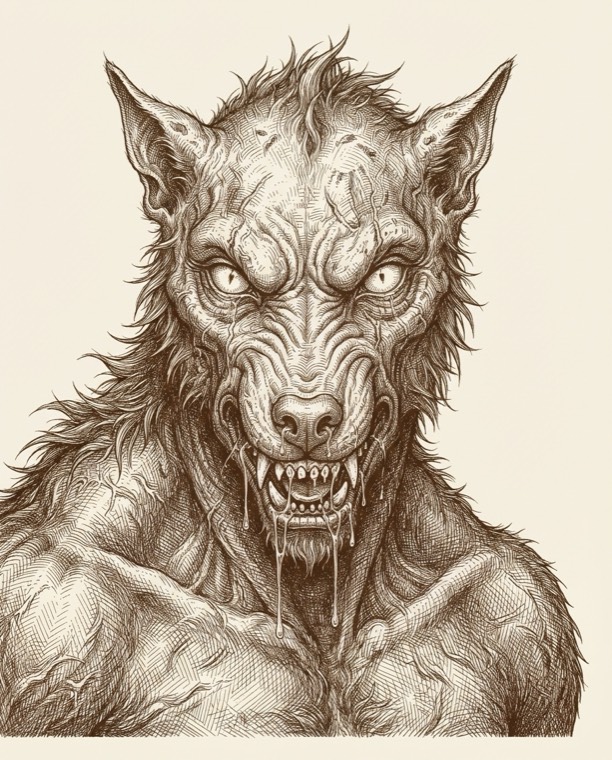
The rougarou is the Louisiana French loup-garou, the werewolf of medieval and early modern France, carried into the bayous by the Acadians expelled from Nova Scotia by the British after 1755. That expulsion, Le Grand Dérangement, scattered thousands of French-speaking families, and the ones who reached south Louisiana became the Cajuns. The creature came with the language.
It is a wolf's head on a man's body, and it is in the swamp, and the essential difference from everything else in this guide is that the rougarou is not primarily a thing you see. It is a thing you might become.
The Lenten telling is the best known. Observe Lent properly for seven consecutive years or you become a rougarou yourself. Told to a child in a Catholic parish in the 1950s, by a grandmother, in French, this is not a ghost story. It is enforcement, and it worked.
The other well-attested strand is the hundred and one days. If you draw the rougarou's blood it returns to human form, and it is then the same person you have always known, and you are bound to say nothing for a hundred and one days. Speak, and the curse comes to you. The mechanism is the point. The story hands you a secret about your neighbour and makes keeping it your problem.
Where the tradition is held
- Terrebonne and Lafourche Parishes, and across Acadiana. The heart of it.
- Houma, Louisiana. The annual Rougarou Fest has run since 2011 and raises
money for wetlands conservation, which is a more coherent piece of folklore than it first appears: the swamp the creature lives in is disappearing at one of the fastest rates on earth.
- Across French North America as loup-garou, in Quebec, Acadia and the
Missouri French communities, in versions going back to the seventeenth century.
On the record
There is nothing to debunk here and the Institute is not going to invent something. No carcass, no photograph, no flap, no hoaxer. What there is instead is an unbroken transmission chain from medieval France through a forced deportation to a specific set of parishes where people still tell it, and where the telling still does a job.
One distinction worth making, because the two get conflated constantly online. Some Great Lakes and northern communities use rugaru or similar for a hairy wild man figure, and that is not this. The Louisiana rougarou is French, Catholic and Acadian in origin. Confusing it with an Algonquian tradition, or with the wendigo, flattens two entirely separate things into one, and the Institute would rather keep the files apart.
The best monster stories are instructions. Keep Lent. Keep your mouth shut. Do not go into the water at night.
Also in the guide: Mothman · Sasquatch · Chupacabra · Wendigo