Chupacabra
the South Texas brush country
The only entry here that keeps turning out to be a coyote.
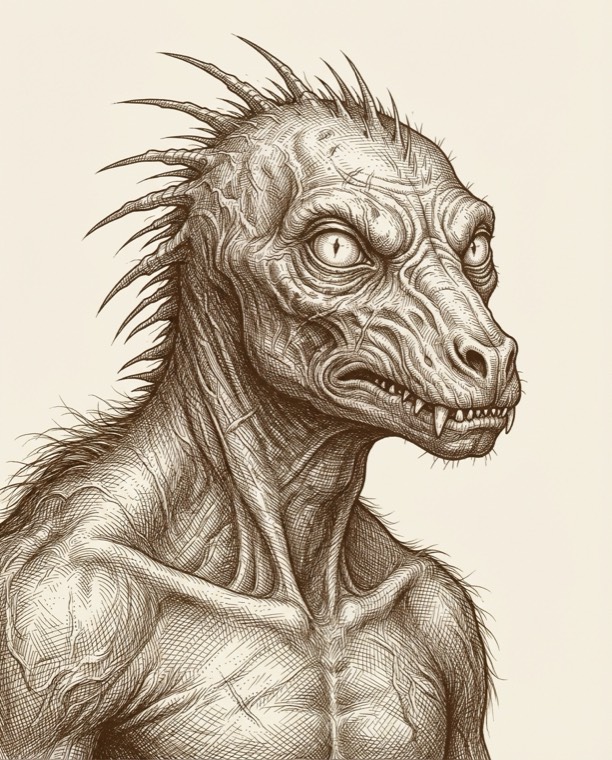
In March 1995, in Canóvanas, Puerto Rico, farmers began finding goats dead with small puncture wounds to the neck and, they said, no blood left in them. The name that attached to it, chupacabras, goat sucker, is exact and unlovely and it spread across the Caribbean, Mexico and the American Southwest within about three years. It is the youngest legend in this guide by a wide margin and the fastest travelling.
The original Puerto Rican descriptions are not the animal most Americans now picture. Witnesses described something bipedal, roughly three to four feet tall, grey, with enormous dark oval eyes and a row of spines or quills down its back that flexed when it moved. It hopped rather than ran.
What crossed into Texas is a different animal entirely, and the name simply travelled to it. Since the early 2000s, ranchers from Cuero to Elmendorf have shot, photographed and occasionally frozen a hairless, blue-grey, long-fanged quadruped that looks like nothing in any field guide. These are real animals. People have held them.
Reported from
- Canóvanas, Puerto Rico, from March 1995. The origin cluster. Mayor José
Soto led armed weekend search parties, which is a matter of public record.
- Elmendorf, Texas, 2004. Devin McAnally shot the animal that became the
Elmendorf Beast on his ranch. Tested at the University of California and at Texas State: a coyote.
- Cuero, DeWitt County, Texas, 2007. Phylis Canion kept the head of a roadside
specimen in her freezer and it made international news. Texas State University sequenced it as a coyote. A fuller analysis at the University of California, Davis found coyote with some Mexican wolf ancestry.
- Blanco and Dewitt Counties, and across northern Mexico. The same animal,
the same result, repeatedly.
On the record
Every North American specimen ever submitted for testing has come back canid. The condition that makes them look the way they do is sarcoptic mange, an infestation by the mite Sarcoptes scabiei, which causes total hair loss, thickens and darkens the skin into grey folds, and leaves the animal emaciated so the teeth and spine stand out. A mange-ridden coyote genuinely does not look like a coyote. It looks like the photographs.
The blood drained from the goats has not survived scrutiny either. Necropsies have generally found the carcasses were not exsanguinated at all. Blood pools and settles internally after death, and a predator that punctures the neck and leaves the body is describing an ordinary canid kill that was interrupted.
There is one more finding worth stating plainly. The investigator Benjamin Radford interviewed Madelyne Tolentino, the most influential of the original 1995 Canóvanas witnesses, and established that the creature she described closely matches the alien character Sil in the film Species, which she had seen shortly before her sighting. The resemblance is not general. It is point by point.
The Institute lists this entry as Documented, on the strength of the physical evidence, and notes that the physical evidence keeps saying coyote.
Something is killing the goats. It has four legs, it is very ill, and it is having a much worse time than the goats are.
Also in the guide: Mothman · Sasquatch · Wendigo · Jersey Devil