Dr. Helen Whitaker and the Splintercat
Filed March 3, 1953 · Recorded by Dr. Helen Margaret Whitaker
The physician who went looking for a diagnosis and found a pattern instead.
The Testimony
I had been in practice in Hollowfield four years by then and I was the only physician for thirty miles, which meant I saw everything and I usually saw it late, after people had tried to manage it themselves.
March brings the crews further up the valley and March brings me the injuries that go with it. Lacerations mostly. Crush injuries. Men who have waited two days.
A crew boss brought in a faller named William Chen with his shirt cut off him. Deep tears across the chest and the shoulder, several of them punctate, at least two ribs gone. Six hours old at a guess. I asked him what had happened and he looked at his hands and did not answer, and when I started writing he asked me not to put it in his file. He asked twice.
The crew boss talked instead. He said Chen had been near the cedar stand when something went through the timber, and that it went in a straight line, and that it moved the way a limb moves coming down except that it was moving sideways. He said they found trees torn open afterwards and wood thrown forty feet in pieces the size of a forearm.
I cleaned the wounds and bound the ribs and gave him what I had. The pattern was wrong for claws and wrong for teeth. Something blunt and very heavy had hit him edge on.
I wrote it in his file. He quit the company that week.
I drove home that evening through the old growth, the stretch where the road bends under the big cedars, and the light was doing the green thing it does in there before the sun goes.
I saw the damage before I saw anything else. A cedar on the right hand side was split open and the fracture went outward from a single point, and there were splinters the length of fence posts lying in a fan across the ground. It was not wind. Wind does not do that and neither does lightning.
I stopped the car.
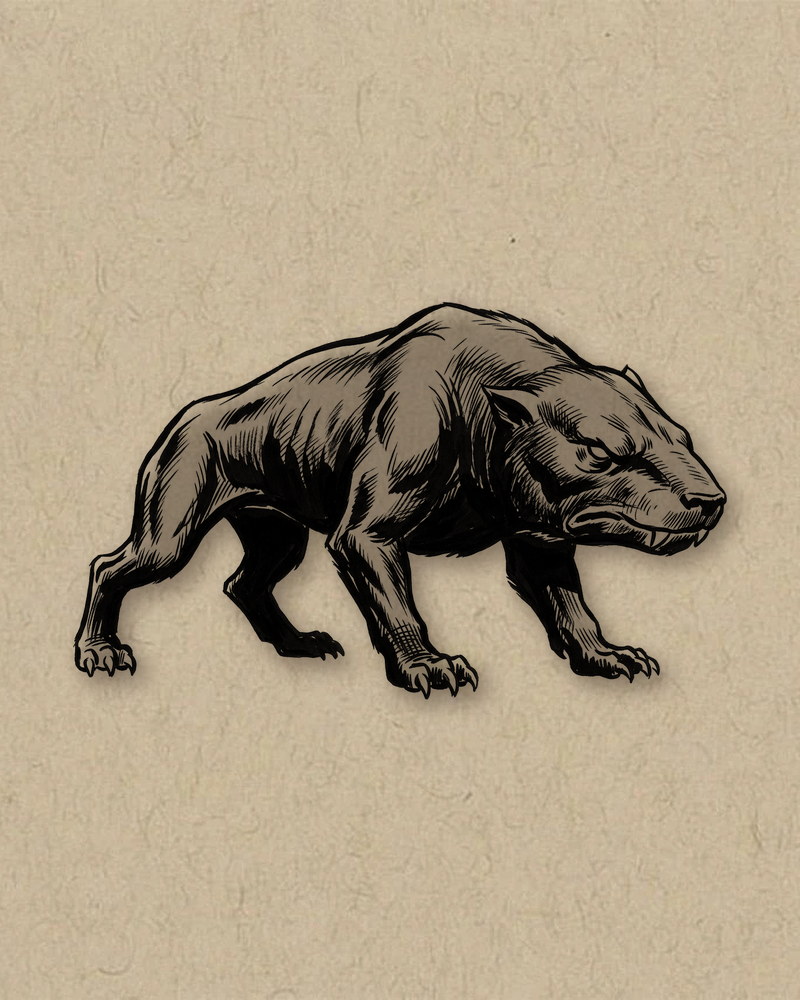
There was an animal on the road ahead of me. Low to the ground and built wrong. The head was enormous, wedge shaped, dense, and the body behind it was lean, as though everything had been given to the front end.
It was walking in a straight line. That is the part I have never got past. Not walking along the road, walking across it, and it did not adjust for the road or for the car or for me. It did not appear to see me at all. It went into the timber on the left and the trees ahead of it came apart as it went.
I drove home and I did not sleep.
I went back the next morning and looked at the cedar properly. The strike point was high and dense and the wood had opened outward from it. I counted rings on the broken face and gave up past two hundred. Whatever hit that tree took it apart in a few seconds.
After that I started asking, carefully, the way you ask a patient about something they have not raised. Most of them shut down. One did not. Arne Danielson was sixty one and had been in those woods his whole life and he told me there was something that came through the cedars at night in a straight line, that it could not turn, and that when it hit a tree the tree came apart. He said the wreckage was always fresh. He said it had been working that ridge for weeks.
I asked what it was after and he said honey, or the animals that live in old growth, and that it did not much matter what was in the way.
I never saw it again. Three more men came to me that month with the same punctate injuries, all from crews working within two miles of that cedar.
I photographed the wounds. I kept the plates. I mapped where the strikes were.
I did not draw a conclusion and I have not drawn one since. What I will say is that I could not make those wounds agree with any explanation I was offered, and that a physician who writes down only the cases she can already account for is not keeping records at all.
Documentation Notes
Investigator: Dr. Helen Whitaker, recording her own account
I am including my own testimony, which I would rather not do, because I am the member of this Institute who argues hardest that most of what comes through the door has an ordinary answer. I still think that. This is one I cannot get there on.
The ordinary explanations, which I have gone through. A widowmaker coming down will kill a man and will throw wood a long way and the injuries would look something like these. It will not travel horizontally through standing timber for a quarter of a mile. A bear will tear a tree apart, and I have seen what a bear does to a cedar, and it is not a single strike opening a trunk outward from one point. A cable under tension accounts for the wounds and accounts for a man not wanting it written down, and it does not account for the cedar or for Danielson.
I want it on the record that the cable is the strongest of those and that I have not been able to dismiss it. Chen would not talk. A man hurt by equipment that should have been condemned has every reason not to.
The name. The Splintercat turns up in logging camp material from the Great Lakes and the Northwest going back to the 1880s and it is told as a joke, an animal that breaks trees with its head because it is after honey and has not the sense to go round. I note that I am describing something that already had a name in the camps, and that Danielson used the name before I did. A witness who has heard a story can produce that story without meaning to. That applies to him and it applies to me.
What is on file. Four men with the same class of injury inside one month and inside two miles. One cedar, photographed, with a strike point and a radial fracture. One account from Danielson, given freely. One from me.
What is not on file. Anything with the animal in it. I have a broken tree and a set of wounds and no photograph, which puts this where most of our files sit.
Why it came to Hollowfield. I wrote this for myself nine months before there was an Institute to give it to, and it reached Miss Merrick's exercise book that autumn, which is how my name came to be among those invited in December. I went to that meeting as the loudest sceptic in the room and I said so. I have not moved since. Documenting a thing does not require believing it. It requires writing down what you saw and then saying, plainly, what it might ordinarily have been.
Filing. Class III.
The creature in this account is catalogued in the field guide, and can be photographed in the app.